Hands-On Math, KP® Ten-Frame Tiles, Math, Teaching and Learning
Becoming a teacher-turned-inventor never crossed my mind earlier in my career. However, since founding KP Mathematics, this is the path I’ve traveled. KP Ten-Frame Tiles, an embodiment of the base-ten number system, came to life as we searched together to find a solution to the problems presented with pre-grouped manipulatives such as base-ten blocks.
As physical and pictorial models, base-ten blocks do an adequate job of illustrating place-value-based quantities. However, everything falls apart when using base-ten blocks to demonstrate the action of grouping and ungrouping tens and magnitudes of ten.
In her article, Choosing the Right Tool, Stacy Boote explains that base-ten blocks have a static form that renders them less useful when demonstrating operations such as division due to the need to group and ungroup. In contrast, when used to demonstrate the area model of multiplication, they will suffice because the action of grouping occurs after the model has done its job.
“When using the area model, exchanges between place values do not occur in the creation of the rectangle or when finding the areas of the four inner rectangles. Renaming occurs at the end of the process, when calculating partial products. Therefore, using materials that can be easily manipulated is not an area model requirement” (Boote, p. 479).
This regrouping issue that exists for long division also appears when representing the operations of addition and subtraction. The need to manipulate the materials for exchanges between place values is an important process. And when using base-ten blocks, the trades that must take place for grouping and ungrouping (aka, carrying and borrowing) obstruct student understanding rather than support it.
Using groupable manipulatives, such as KP Ten-Frame Tiles, craft sticks, or unifix cubes, requires less cognitive load because the actions children demonstrate are relevant to the mathematics they are learning. When students are “regrouping,” they literally group and ungroup rather than “trade,” which is the only option with pre-grouped manipulatives such as base-ten blocks.
So, you may ask, how do we resolve this issue? The answer is simple…use groupable manipulatives when the mathematics being modeled requires the action of grouping and ungrouping. KP Ten-Frame Tiles, craft sticks, or unifix cubes are a few options. It’s okay to use pictures of base-ten blocks to help kids visualize quantities, especially given this is the most common model used in testing situations. But when students need to manipulate to represent the movement between places, groupable models are the way to go.
If you’d like to learn more, I recommend reading the groupable vs. pre-grouped manipulatives section in Teaching Student-Centered Mathematics, or the article linked above, Choosing the Right Tool. And take a look at Peggy’s series of journal entries, Beyond Base Ten Blocks.
Kimberly Rimbey, Ph.D., works with teachers and leaders to develop system-wide change in mathematics teaching and learning.
After reading this post, please join in on the conversation! What have been your experiences with pre-grouped manipulatives such as base-ten blocks? What have been your successes and challenges? We always love to hear from you!
Hands-On Math, Professional Learning, Teaching and Learning
By Kim Rimbey
The first day of school has a magic all its own. The buzz in the air. The fresh notebooks and sharpened pencils. The energy of new beginnings. For me, that feeling never went away—after all, I’ve had a first day of school every single year since I was five. (And yes… I still treat myself to a new outfit and lunchbox. Every. Single. Year.)
That same excitement doesn’t just come from seeing familiar faces or decorating bulletin boards. It also comes from knowing you’re ready—supplies gathered, tools prepped, and ideas flowing. At KP Mathematics, we want to make sure your math toolkit sparks that same ready-to-roll confidence. Even if the school year’s already underway, it’s never too late to stock up on the essentials that help students truly see and understand the math.
This week, we’re sharing our favorite math supplies—organized by representation type, following the Lesh Translation Model for Representations—plus a few lists of can’t-live-without general supplies and my personal favorite math books.
You probably won’t need everything on this list. You may not want everything on this list. But it will help you think about what’s missing and spark ideas for setting up your classroom for student success.
Let’s dive in.

Physical Tools
- KP Ten-Frame Tiles
- Base-Ten Blocks (I use BTBs sparingly – I use KP Ten-Frame Tiles for almost all NBT standards)
- Two-Color Counters (I call them “integer chips” for grades 6+)
- Pattern Blocks
- Snap Cubes
- Unit Square Tiles (one-inch)
- Unit Cubes (one-inch)
- Fraction Pieces (unmarked circles, bars, squares, etc.)
- Cuisenaire Rods
- Algebra Tiles (grades 6+)
Visual Tools
(I like laminated class sets—they’re perfect for BTC and work beautifully next to your VNPS.)
- Place Value Mats ([compatible with KP Ten-Frame Tiles])
- Dollar Boards and Coin Cards (KP Math exclusive)
- Hundreds Charts (0–99)
- Hundreds Charts (1–100)
- Ten Frames
- Double Ten-Frames
- Bar Model/Tape Diagrams
- Number Lines
- Open Number Lines
- Open Arrays (multiplication & division)
- Graph Paper
- Coordinate Grids (first quadrant)
- Coordinate Grids (four quadrants)
- Various geometric figures (as per your program/textbook)
Symbolic Tools
- Cards
- Dice
- Calculators
- Numeral, Number, and Symbols Charts
Verbal Tools
- Anchor Charts
- Sentence Frames
Contextual Tools
- Rulers
- Tape Measures
- Yard/Meter Sticks
- Balance Scales
- Weights
- Measuring Cups
- Clocks
- Coins & Bills
- Word Problem Frames
- Problem-Solving Cue Cards
Don’t Forget These Supplies
- Building Thinking Classrooms must-haves:
- Vertical Non-Permanent Surfaces (whiteboard surfaces)
- Dry-Erase Markers—get lots
- Erasers (microfiber cloths are my favorite)
- Individual Whiteboards
- Writing & Art Supplies:
- Reams of blank paper
- Construction/colored paper
- Grid paper
- Watercolor markers (Crayola—both fine and broad tip)
- Colored pencils
- Pencils in different sizes (students love choice)
- Tape
- Scissors
- Glue sticks
Kim’s Favorite Books (in 2025)
KP Mathematics Tools
Back-to-school is all about possibility. A well-stocked math classroom doesn’t just make your life easier—it sets the stage for deeper learning, richer conversations, and those lightbulb moments we live for.
Here’s to a year of math magic!
Kimberly Rimbey, Ph.D., works with teachers and leaders to develop system-wide change in mathematics teaching and learning.
Hands-On Math, Professional Learning, Teaching and Learning
Why Making Math Visible Matters
By Kim Rimbey
Math is the study of patterns.
Math is a way of thinking. Math helps us describe the world—quantitatively and abstractly.
Math has many expressions.
But here’s the thing: If we can see it, THEY can see it.
When it comes to teaching and learning math, getting the thinking out of our heads and into the world is essential. Visible thinking helps us communicate clearly, uncover misconceptions, and build shared understanding.
That’s exactly why we wrote Seeing the Math You Teach—to support teachers, parents, and students in making their math thinking visible. “Seeing = Understanding.” With the understanding that there are multiple solution paths to any problem, the book offers a variety of visual strategies that help learners represent and explain their ideas.
Number Lines: More Than Meets the Eye
While prepping for a recent conference, I took a deep dive into one of our most powerful tools: the number line.
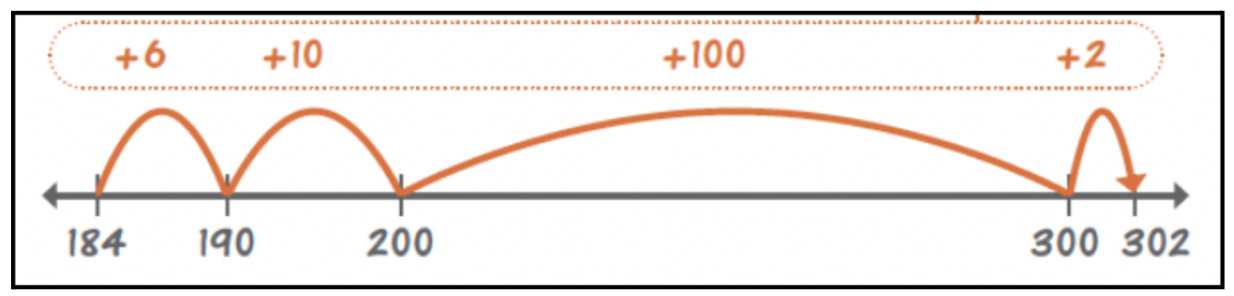
We often start with number tracks—like snap cube trains—to help young learners count units. Then, we shift to number lines with tick marks. But this shift calls for a shift in focus, too. It’s the spaces between the tick marks that matter. That’s where the “jumps” happen. That’s where the math lives.
Rimbey, K., Basham, K, Berda, C. (2025). Seeing the Math You Teach. Corwin: Thousand Oaks, CA.
And no matter what the intervals—1s, 10s, 25s, millions, fractions—every point on a number line represents a distance from zero.
This is true even if zero isn’t shown. Even if we’re looking at just a portion of the number line, the meaning of every number still depends on how far it is from zero. And it’s true for open number lines as well. Even though the jumps may not be proportional, they still represent the distance traveled from zero. It’s all about relational thinking.
Rimbey, K., Basham, K, Berda, C. (2025). Seeing the Math You Teach. Corwin: Thousand Oaks, CA.
Quick Teacher Check-In: Do your students understand that every value on a number line—visible or open—is a measure of its position relative to zero?
As students start representing their thinking using number lines, we need to help them see what they’re showing—even when zero is nowhere in sight.
Letting Students SEE and BUILD the Math
Here’s the hard truth:
We can’t just tell students what to see. They need to explore, discuss, make mistakes, and revise.
And for that to happen, we need to create learning environments that encourage deep thinking and collaborative sense-making.
Enter…Vertical Non-Permanent Surfaces (VNPSs)
VNPSs—think whiteboards, whiteboard cling film, windows, chart paper, etc.—are erasable vertical spaces where students stand, collaborate, and represent their thinking.
Peter Liljedahl’s Building Thinking Classrooms popularized this approach, and I’ve seen firsthand how transformative VNPSs can be.
For Students
- Interact and record their thinking
- Erase, rework, and revise as they learn
- Represent ideas in multiple ways
- See other groups’ strategies
- Stay on their feet and activated
For Teachers
- Easily scan every group’s work
- Step in briefly to nudge, hint, or extend
- Plant seeds and move thinking forward
- Select and sequence work to meet learning goals
- Spotlight key ideas—like number lines and distance from zero
But What If I Don’t Have Enough Whiteboards?
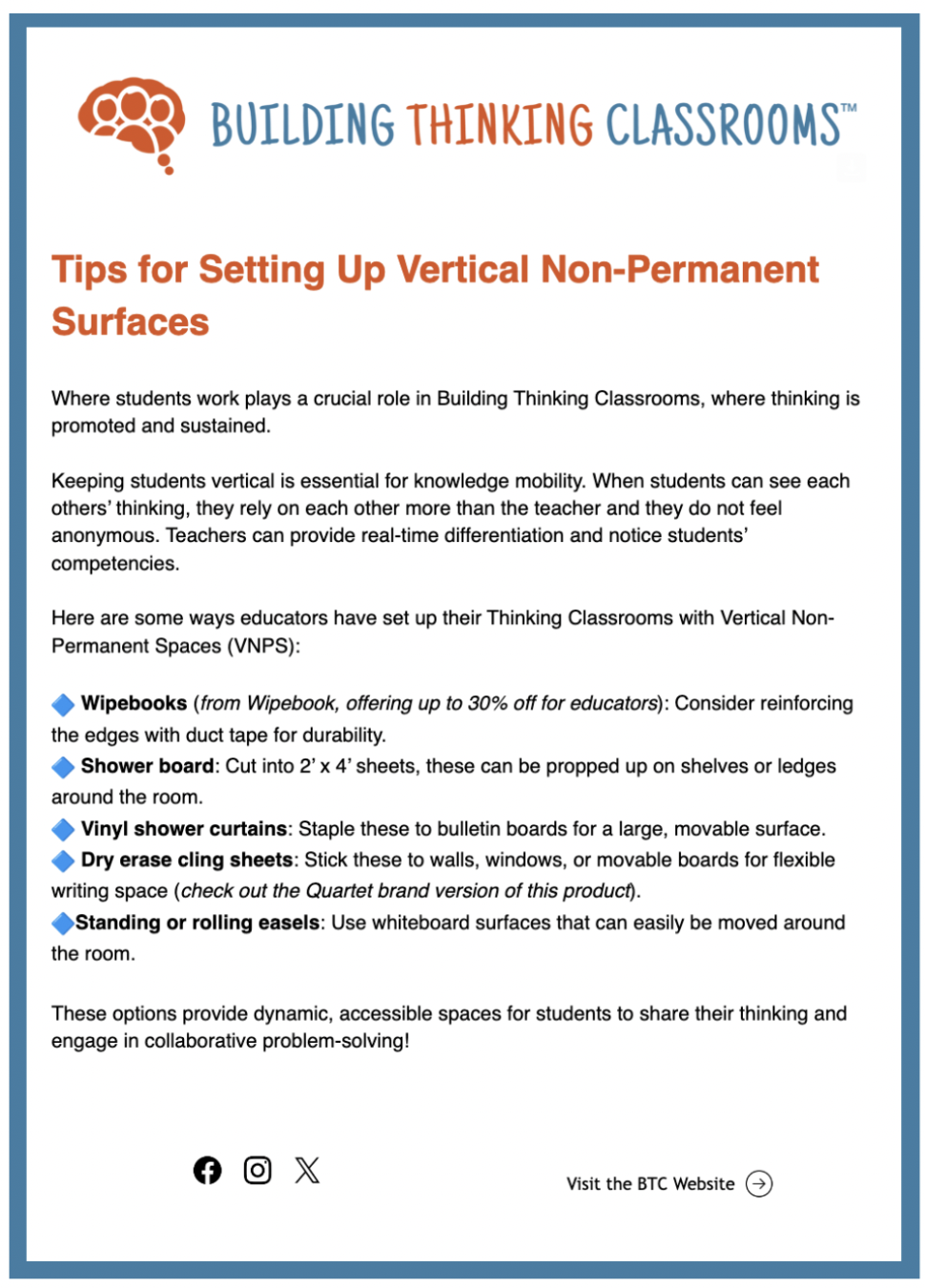
Good news—VNPSs aren’t about expensive equipment. Here are some ideas for where to find inexpensive VNPSs (from the Building Thinking Classrooms update posted on June 2, 2025 – used with permission – click here to subscribe):
Your Next Steps
For Teachers
Two big ideas, two next steps:
- How might you talk about number lines in a way that conveys “distance from zero” as the central idea?
- How might you incorporate VNPSs (or use them more intentionally) to support visible, collaborative math thinking?
- Which visual do you use to support your students’ thinking? For more ideas on number lines and many other visuals, check out my newest book, Seeing the Math You Teach.
For Leaders
Same two ideas, new lens:
- How might you build shared understanding during PLC/planning sessions around the idea that number lines represent distances from zero? How might you facilitate doing math together?
- What barriers can you remove to ensure teachers have access to VNPSs and the tools to use them effectively?
Final Thoughts
Let’s keep helping students see the math we teach.
Let’s help them own their thinking.
Let’s keep learning—together.
Interested in Workshops by Kim Rimbey?
Kim offers workshops on a variety of topics, including Building Thinking Classrooms, Ten-Frame Mathematics, Mastering Math Manipulatives, Small-Group Math Instruction, and See the Math You Teach: A New Vision for Math Teaching and Learning. View Kim’s PD Catalog to learn more.
Kimberly Rimbey, Ph.D., works with teachers and leaders to develop system-wide change in mathematics teaching and learning.
Hands-On Math, Professional Learning, Teaching and Learning
Math Makes Sense
By Katie Basham
I wish I had known that when I was a young, impressionable student. Maybe some kids knew it—maybe they even believed it—but I certainly didn’t. I was the kid counting on my fingers, skip-counting under my breath, and hoping no one would notice. I thought of these methods as “less-than” strategies and felt a pit in my stomach at the thought of others noticing me using them.
Everyone Can Be Good at Math
Also true. And I wish my teachers had known that, too. Maybe then I would’ve felt proud of my own strategies, instead of ashamed. Because here’s the truth: success doesn’t belong to a select few. It’s not limited. There’s enough of it for every single student to feel it, own it, and believe in it.
These two beliefs—math makes sense and everyone can be good at math—are the foundation of Seeing the Math You Teach. Success shouldn’t be reserved for an elite few. All students can succeed when they understand that math is really about visualizing and explaining abstract thinking. Because when students can see the math, they can understand it….and, when they understand it? It makes sense.
What a privilege we have as educators.
It’s no longer our job to bestow knowledge from on high. Our mission is to create learning environments where students use concrete materials, build visual representations, and gradually progress to symbolic understanding. This book is designed to empower you—to help you see and understand the math you teach, so you can help your students do the same.
Take rounding, for example.
I recently asked a respected educator how he would explain it. Here’s how the conversation went:
Me: “What does it mean to round a number?”
Him: “Five or more, raise the score. Four or less, let it rest.”
Me: “But what does that mean?”
Him: “It means if the number ends in a five…”
As you can see, we weren’t quite getting to the heart of it.
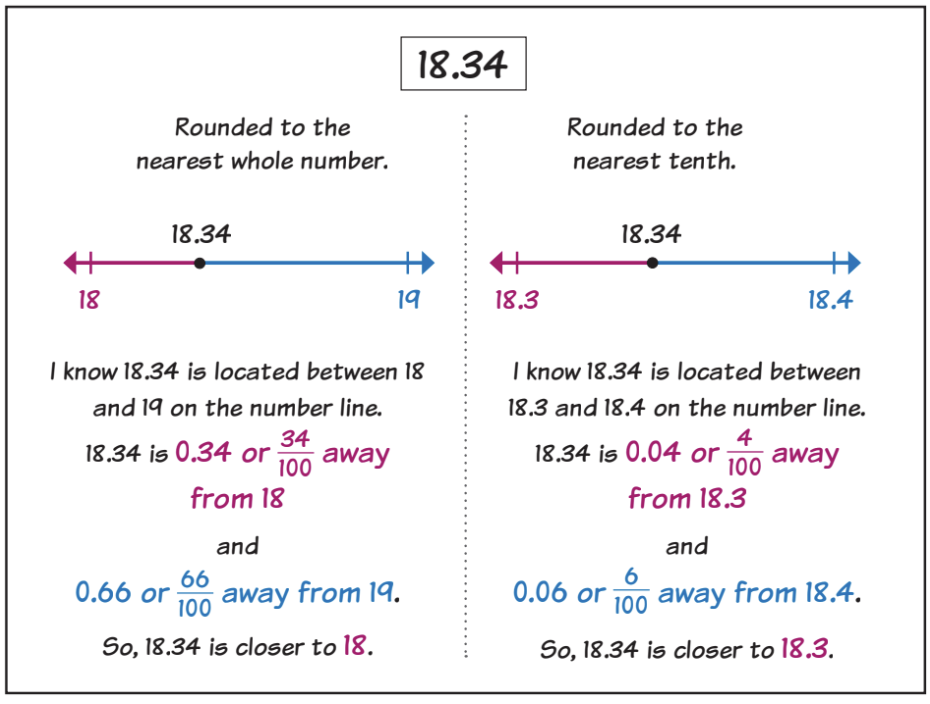
“Rounding” isn’t really something you do, like an action—it’s more about understanding where a number falls in relation to benchmarks or friendly numbers. In other words, rounding is determining which number a given value is closest to.
- What number is nineteen closer to?
- What number is 18.34 closer to?
- THAT’S what rounding is.
Rimbey, K., Basham, K, Berda, C. (2025). Seeing the Math You Teach. Corwin: Thousand Oaks, CA.
The student who can show rounding on a number line isn’t just repeating a rhyme—they’re seeing the math. They’re understanding the concept. And that, at its core, is what this book is about.
We want you—and your students—to experience success.
Because: Math Makes Sense & Everyone Can Be Good at Math!
Interested in Workshops by Kim Rimbey?
Kim offers workshops on a variety of topics, including Building Thinking Classrooms, Ten-Frame Mathematics, Mastering Math Manipulatives, Small-Group Math Instruction, and See the Math You Teach: A New Vision for Math Teaching and Learning. View Kim’s PD Catalog to learn more.
Professional Learning, Teaching and Learning
 What is fluency? As a literacy specialist in my early career, I equated the word “fluency” with the ability to read with automaticity, accuracy, and prosody (expression using the patterns of rhythm and sound). Simply put, a fluent reader expresses herself fluidly and with expression. I understood fully that fluency is not the same as comprehension, and yet it contributes immensely to the ability to get to the higher levels of thinking required to comprehend well.
Several years later, as I shifted toward a mathematics specialization, I discovered that there is a mathematical equivalent to reading fluency. Much like reading fluency helps children succeed in higher levels of comprehension, mathematical fluency plays a foundational role in helping children succeed in problem solving. Therefore, just as students who struggle with reading fluency find comprehension tasks difficult, students who struggle with mathematical fluency find problem solving tasks difficult. For me, thinking about this in the form of an analogy helps illuminate the relationship:
Reading Fluency : Comprehension :: Mathematical Fluency : Problem Solving
So…what is mathematical fluency, and how can we develop it as a foundation that leads to stronger problem solving? This topic has many layers, and we’ll be revisiting it often over the next several weeks. For now, let’s take a look at what it is not.
Mathematical fluency cannot be reduced to memorization. This limited view of fluency puts undue pressure on students to focus on rote recall of facts. The mathematics community has agreed upon four qualities that comprise mathematical fluency:
- Accuracy: finding the correct answer
- Efficiency: using strategies or methods that allow for ease and flow while solving
- Flexibility: knowing more than one approach to solve a problem and then selecting one that provides for efficiency
- Appropriateness: knowing when to apply a particular procedure, strategy, or method
Students who are mathematically fluent are able to choose flexibly from a variety of methods and strategies to solve problems, and they solve them accurately and efficiently.
Mathematical fluency is not limited to knowing and using basic facts. Rather, it is much broader, involving concepts such as number sense, math facts, multi-digit operations, fraction operations, problem solving — and the list goes on (see below for more on this). Children need opportunities to develop fluency with the concepts on which they are focused at any given time. Students at the elementary level should have opportunities to develop fluency in at least four areas:
- Number Sense: thinking about numbers and number relationships fluidly and flexibly.
- Math Fact Fluency: adding numbers through 10+10 and the related subtraction facts; multiplying numbers through 10×10 and the related division facts.
- Operational Fluency: using strategies to add, subtract, multiply, and divide whole numbers, decimals, fractions, and integers.
- Problem Solving Fluency: selecting from and applying a variety of strategies and methods with the goal of solving a contextual or mathematical problem.
Mathematical fluency does not just happen spontaneously. Fluency develops over time as students are given multiple opportunities to focus on mathematical relationships and manipulations, often as a result of engaging in deliberately designed and sequenced experiences. Here are a few examples to get you started (more to follow in the coming posts):
- Number Sense: use ten frames to help students understand relationships among numbers, both large and small. Ten frames needn’t be restricted to numbers within ten – they can be used to explore multi-digit numbers, decimals, and integers, as well! At KP Mathematics, we call this the “infinite ten frame,” and I’ll share more during this fluency series.
- Math Fact Fluency: use card and dice games to allow students to practice their math facts in ways that are enjoyable and build confidence. For example, Double War is a simple card game where pairs of students each flip over two cards and either add or multiply the two numbers. Each student calls out his sum or product. The student with the greater (or lesser) sum or product takes all four cards. Repeat until all cards are used.
- Operational Fluency: implement daily Number Talks with your students. This robust-yet-simple daily routine helps students develop number sense and mental math skills while focusing on developing operational fluency.
- Problem Solving Fluency: engage students in daily problem solving, giving them tasks that require them to use strategies other than standard algorithms. For example, engage young children in solving a division problem before teaching them “how” to divide. Observe how they approach the process. Provide them with tools and manipulatives to guide their thinking. Resist the temptation to jump in – let them struggle. They will amaze you!!!
If you’re wanting more ideas in each of these categories, tune in for the next few weeks as we unwrap each category and share specific classroom-tested ways to develop fluency with your students.
For now, let’s carry on this conversation. What is your understanding of math fluency? What do you do in your classroom to develop fluency among your students? Please leave your comments in the boxes below.
Kimberly Rimbey, Ph.D., works with teachers and leaders to develop system-wide change in mathematics teaching and learning.